


Last updated: November 15, 2026
Fractional CO2 laser is an ablative skin resurfacing treatment that creates microscopic columns of treated skin while leaving surrounding skin intact. That pattern can improve texture, fine lines, and selected scars while generally allowing faster healing than a full-field CO2 treatment, though results and recovery vary.
What Is a Fractional CO2 Laser?
A fractional CO2 laser removes tissue in a grid of microscopic treatment columns rather than across the entire skin surface. The Cleveland Clinic explains that skin around the columns remains untreated. An article on the American Board of Cosmetic Surgery’s website explains that CO2 energy is absorbed by water in tissue, producing a controlled injury that supports skin renewal.
What Are Ablative Laser Treatments?
Ablative lasers remove or vaporize treated surface tissue. During CO2 laser resurfacing, energy also heats deeper skin, prompting collagen remodeling as the area heals. “Fractional” describes where the laser delivers that energy: the treatment columns are separated by untouched skin. It does not mean the procedure is nonablative or free of recovery.
Who Is Fractional CO2 Laser Resurfacing Best Suited For?
Fractional CO2 laser resurfacing may suit adults seeking improvement in fine lines, rough or uneven texture, selected acne scars, and visible sun damage. Suitability depends on the type and depth of the concern, skin tone, medical history, and the correction a person hopes to achieve.
Is a CO2 Laser Good for Fine Lines, Acne Scars, and Uneven Skin?
Yes. CO2 resurfacing can improve fine lines, uneven texture, and some acne scars, although results depend on scar type, depth, and the treatment plan. For concerns centered on sun spots or redness, intense pulsed light photofacial treatment may be worth discussing; professionally supervised chemical peels are another resurfacing option.
Can Fractional CO2 Laser Treat Melasma or Deep Wrinkles?
Melasma should not be treated as a routine indication for fractional CO2. Heat and inflammation can worsen pigmentation in some people, so identifying the cause of discoloration and assessing skin tone matter before choosing a treatment. Fractional CO2 may improve some wrinkles, but a full-field approach can offer more substantial correction for deeper changes, with a greater recovery burden.
How Does Fractional CO2 Compare With Full-Field CO2 and Other Lasers?
Fractional CO2 leaves skin between treatment columns untreated and generally heals faster, while full-field CO2 may offer more substantial correction for deeper changes at the cost of longer recovery. Other lasers offer different trade-offs:
| Option | How it treats skin | Potential use and recovery trade-off |
|---|---|---|
| Fractional CO2 | Removes tissue in separated columns, leaving surrounding skin untreated | May improve wrinkles, texture, and selected acne scars; generally heals sooner than full-field CO2 |
| Full-field CO2 | Treats the planned surface continuously | May provide more substantial correction for pronounced wrinkles or extensive surface damage, with longer recovery. The Cleveland Clinic estimates up to two weeks of recovery for CO2 resurfacing generally, not a fixed time for full-field treatment; healing depends on treatment extent and settings. |
| Ablative erbium | Removes surface tissue using a different laser | Can address superficial to moderately deep wrinkles; may cause less swelling and redness than CO2 resurfacing |
| Nonablative laser resurfacing | Heats skin without removing surface tissue; it can also use a fractional delivery pattern | Generally causes less surface injury and shorter downtime than ablative resurfacing but may offer less substantial improvement |
Why Can Fractional CO2 Heal Faster Than Full-Field CO2?
Untreated skin between the columns helps the treated areas heal. A lighter fractional pass may provide less correction than an extensive full-field treatment. The Cleveland Clinic also cautions that fractional CO2 can penetrate deeply enough to pose risks of difficult healing and scarring, despite leaving much of the surface untreated.
What Are Some Brands of Fractional Lasers?
The American Board of Cosmetic Surgery’s laser resurfacing guide lists Fractora and Fraxel as fractional-laser brands and CO2RE separately as a CO2 laser brand. A brand name alone does not establish that a particular device provides fractional CO2 treatment.
What Happens During a Fractional CO2 Laser Treatment?
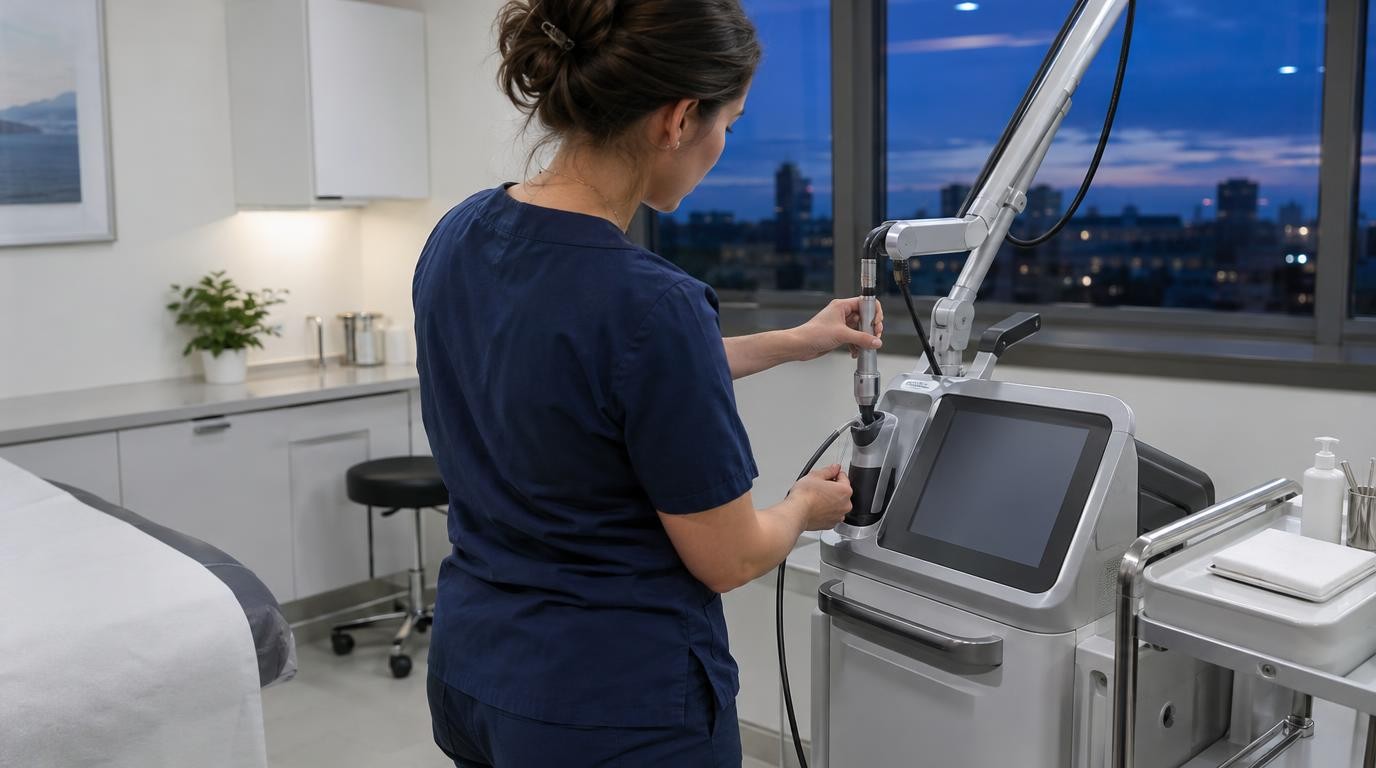
Treatment generally begins with assessment and cleaning, followed by numbing as needed and eye protection, fractional laser passes, and aftercare instructions. The extent of treatment and comfort measures depend on the area and planned depth of resurfacing; these are general steps, not a protocol for a particular clinic or device.
How Is the Treatment Area Prepared?
The clinician assesses the area, reviews relevant health information, and selects a preparation and comfort plan. The skin is cleaned, and appropriate eye protection is provided. The American Society of Plastic Surgeons’ procedure page notes that clinicians may numb the skin and use additional comfort measures for more extensive treatment.
What Happens During the Laser Resurfacing Procedure?
- Confirm the treatment plan: The clinician identifies the area and selects settings suited to the concern and skin.
- Protect the eyes: Appropriate eyewear or shields help prevent unintended laser exposure.
- Deliver controlled passes: The handpiece places fractional treatment columns within the planned area.
- Review aftercare: The patient receives instructions tailored to the treatment and their skin’s response.
How Long Does Recovery Take After Fractional CO2 Laser?
The Cleveland Clinic estimates one full week of recovery after fractional laser resurfacing. Depth, settings, treatment area, and individual healing can change that timeline. Redness, swelling, sensitivity, and peeling can occur during initial healing.
What Should You Expect While the Skin Heals?
An article on the American Board of Cosmetic Surgery’s website describes pinpoint oozing and a bronzed appearance before treated skin sheds; pinkness may persist for several weeks. It says most patients feel ready for video calls by day five and can return to in-office work with makeup by the end of week one after CO2 resurfacing. Those are general estimates, not guarantees for a particular fractional CO2 treatment. Wait until the treated surface has healed and your treating clinician says you can use makeup.
How Should You Care for Skin After Resurfacing?
Follow the treating clinician’s instructions for cleansing, moisturizing, and protecting healing skin from the sun. Avoid picking at peeling skin, which can interfere with healing. A review of wound-healing care after ablative laser resurfacing found mixed evidence for postprocedure products and emphasized choosing a skincare plan for the individual clinical situation rather than applying a universal regimen.
What Results Can You Expect From Fractional CO2 Laser Resurfacing?
Fractional CO2 laser resurfacing can gradually improve skin texture, fine lines, and the appearance of selected scars or sun damage, but it does not guarantee their removal. Visible change develops as surface skin heals and collagen remodels. The outcome depends on the concern, scar type, pigmentation, treatment depth, and whether further sessions are appropriate.
When Might Changes in Texture and Fine Lines Become Noticeable?
Texture may look different once initial healing and peeling settle, although lingering pinkness can make results difficult to judge. An article on the American Board of Cosmetic Surgery’s website says collagen remodeling can continue for up to six months after an appropriately aggressive CO2 resurfacing session. That remodeling period is not the duration of the result: Johns Hopkins Medicine says improvements from ablative laser resurfacing often last for years, but this is not a fractional CO2-specific guarantee. The timing and duration of improvement vary, and aging and sun exposure continue to affect the skin.
Will Acne Scars or Sun Damage Disappear Completely?
Improvement is a more useful goal than complete removal. Some acne scars respond better than others, and discoloration may have causes that require a different approach.
What Are the Risks of Fractional CO2 Laser, and Who Should Avoid It?
Redness, swelling, and sensitivity are expected short-term effects, while infection, lasting pigment changes, scarring, and cold-sore reactivation are possible complications. Darker skin tones may face a greater risk of post-inflammatory pigment change. Discuss your skin, medications, and medical history with your own clinician before treatment.
Can Fractional CO2 Laser Cause Hyperpigmentation or Scarring?
Yes. Fractional delivery leaves surrounding skin intact but does not eliminate pigment or scar risks. A published retrospective review provides context, though its findings should not be treated as a personal risk estimate.
In a retrospective chart review published in 2018, The Safety of Laser Skin Resurfacing With the Microablative Carbon Dioxide Laser and Review of the Literature reported the following findings for the device and clinical centers studied:
| Measure | Finding in the 2018 review |
|---|---|
| Procedures reviewed | 1,081 |
| Recorded complications | 13 procedures (1.3%) |
| Types recorded | 11 cases of prolonged redness and 2 of post-inflammatory hyperpigmentation |
| Scarring recorded | No cases |
The review was retrospective and concerned a particular microablative CO2 system. Its figures cannot predict complication rates for other devices, settings, or patients.
Which Health or Skin Concerns Need Assessment Before Treatment?
Active acne or a skin infection may require postponing resurfacing, as may an unhealed treatment area. A history of difficult wound healing, cold sores, connective-tissue disorders, or certain medications can also change the plan. Skin tone and a tendency toward pigment changes matter: CO2 lasers can cause lighter patches, particularly in darker skin.
Seek prompt medical assessment for worsening pain, spreading redness, pus, or fever after treatment. Seek urgent care for a new vision change or severe eye pain; do not assume these symptoms are part of normal healing.
Frequently Asked Questions
Does fractional CO2 laser treatment hurt?
Fractional CO2 laser resurfacing can be painful, but local anesthetic can numb the skin. Sedation or other anesthesia may be used for more extensive resurfacing; the approach depends on the area and extent of treatment.
How long does a fractional CO2 laser appointment take?
Procedure time depends on the area and technique. Mayo Clinic says ablative laser resurfacing typically takes 30 minutes to two hours; that is not a fractional CO2-specific appointment length. Cleaning, numbing, and postprocedure care can add to the time spent at the clinic.
Is an IPL photofacial the same as fractional CO2 resurfacing?
No. An IPL photofacial uses pulsed light rather than a laser and can target concerns such as sun spots or redness. Fractional CO2 is an ablative laser treatment that removes microscopic columns of tissue. Our team can help you compare these options for your main concern.
How many fractional CO2 laser sessions will I need?
You may need more than one session, but there is no fixed number for fractional CO2 resurfacing. Mayo Clinic notes that patients treated with fractional devices will likely need more than one treatment. The number depends on the concern, settings, healing, and response to an initial session.
Can fractional CO2 laser tighten sagging skin?
Fractional CO2 may modestly tighten or firm skin as collagen between treatment columns contracts, but it cannot lift significantly sagging skin. A facelift or neck lift addresses a different concern from surface texture and modest firming.
How long do I need to protect my skin from the sun after fractional CO2 laser?
Protect your skin from the sun throughout healing and while pinkness persists. An article on the American Board of Cosmetic Surgery’s website says pinkness may linger for several weeks and that diligent sun protection during this phase helps avoid post-inflammatory hyperpigmentation. Follow your aftercare instructions on when sunscreen can be applied to the healing surface.
Is an erbium laser a better choice than fractional CO2 for darker skin?
Erbium resurfacing may be a better option for some people with darker skin, though skin tone alone does not rule out CO2 treatment. The Cleveland Clinic notes that erbium laser may be a good choice for darker skin tones and generally causes less swelling, bruising, and redness than CO2 laser resurfacing. Both options still require attention to pigment-change risks.
How Can You Decide Whether Fractional CO2 Is Right for You in Newport Beach?
Start by identifying your main concern, then weigh the desired degree of correction against recovery and pigment risks. Coral Surgery Center (formerly Distinction Surgical Center) offers laser skin resurfacing in Newport Beach, California.
Our team can explain which laser devices we use and help you compare laser skin resurfacing with our IPL photofacials and chemical peels. Contact Coral Surgery Center to arrange a consultation.
This information is general and is not medical advice. Talk to a licensed clinician about your own situation before making a treatment decision.
