

Last updated: October 25, 2026
The recovery time for thigh lift surgery varies with the procedure, but the American Society of Plastic Surgeons thigh lift guide places a return to normal daily activities in weeks 4-5, while Cleveland Clinic says most people resume daily activities within six weeks. Light activity may become manageable sooner if your surgeon permits it.
How Long Is the Recovery Time for Thigh Lift Surgery?
Plan on roughly four to six weeks to resume usual daily activities; Cleveland Clinic says full recovery can take up to six months. The extent of skin removal and placement of the incisions affect how movement may strain the surgical site, so your surgeon’s instructions—not a general timeline—determine when you can increase activity.
These phases can help you plan without treating any milestone as a deadline:
| Recovery phase | What the guidance describes |
|---|---|
| Early recovery | Cleveland Clinic’s general advice is to rest the legs as much as possible for up to 10 days; your surgeon may give different instructions for your procedure. |
| Return to routine | The American Society of Plastic Surgeons lists normal daily activities in weeks 4-5, while still avoiding heavy lifting and exercise; Cleveland Clinic says most people resume daily activities within six weeks. |
| Later healing | Cleveland Clinic describes incision healing at about six weeks; a healed incision does not mean the contour has finished changing. |
What can you expect during the first two weeks?
During week 1, monitor pain, swelling, and bruising. The American Society of Plastic Surgeons thigh lift guide recommends limiting exercise and other activities in weeks 2-3. For a full-length vertical thigh lift, a surgeon quoted in an American Society of Plastic Surgeons article advises strict leg elevation for two to three weeks. Ask your surgeon how to balance prescribed rest or elevation with permitted movement; do not assume that rest means complete bed rest.
What changes between weeks two and six?
Daily tasks may become easier as tenderness and swelling improve, but exercise and lifting can remain restricted after you feel ready to move around the house. Follow-up checks help your team assess whether the incisions can tolerate more activity. A return to desk work or errands is not the same as clearance for a workout or physically demanding caregiving.
What Is a Thigh Lift, and Why Does the Procedure Affect Recovery?
A thigh lift, also called thighplasty, removes excess thigh skin and reshapes the area. The American Society of Plastic Surgeons procedure overview explains that skin and fat may both be reduced. For one inner-thigh technique, Johns Hopkins Medicine describes an incision where the inner thigh meets the pubic area: the surgeon removes excess skin and fat, then tightens the remaining skin. That technique may use general anesthesia or twilight sedation. Other thigh lifts may use different incisions and anesthesia; the planned approach affects movement restrictions, wound care, and scars.
Loose thigh skin may remain after substantial weight loss even when a person’s weight is stable. For readers considering other areas of loose skin as well, our body contouring after weight loss guide explains how surgical options address different areas. The recovery plan for one operation should not be assumed to apply to another.
How can an inner thigh lift differ from more extensive thigh skin removal?
An inner thigh lift addresses loose skin along the inner thigh; laxity extending farther down or around the leg may require a longer incision. An American Society of Plastic Surgeons article on thigh-lift recovery says some patients recover within one to three weeks, depending on the technique, while others need longer. The Society also describes roughly three to four weeks of recovery for a lower-body lift involving the outer thighs and identifies a full-length vertical thigh lift as having the most intense recovery. These descriptions concern different operations: they do not replace the general four-to-six-week daily-activity timeline or the six-to-eight-week estimate below for comfortable standard or brisk walking after certain inner-thigh lifts. Combining another operation with a lift may add incisions and wound-care needs.
How Painful Is Thigh Lift Recovery?
Early recovery commonly involves soreness, tightness, bruising, and swelling, but there is no predictable pain level for everyone. Cleveland Clinic notes that large incisions may be sensitive to movement, temperature, and touch, and that prescription or over-the-counter medicines can help you stay comfortable.
How are discomfort, swelling, and incision care managed early on?
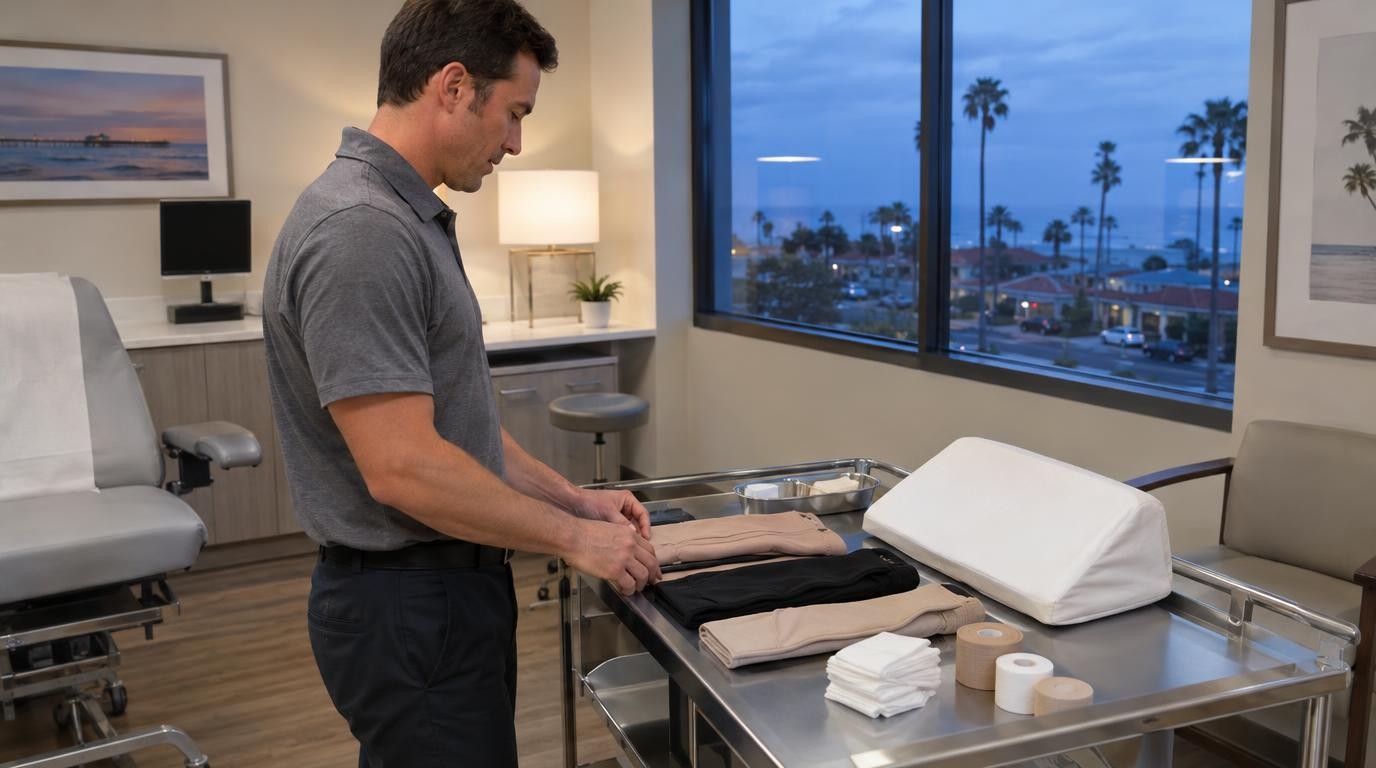
Take pain medicine according to your postoperative instructions, and care for incisions, dressings, and any drains as directed. The American Society of Plastic Surgeons thigh lift guide says compression can help reduce swelling and support the healing thighs; temporary drains, when used, remove excess blood or fluid. Follow your prescribed garment schedule rather than someone else’s recovery routine.
How Long After a Thigh Lift Can You Walk or Exercise?
Brief, surgeon-approved movement may be possible early in thigh lift recovery, but comfortable walking and strenuous exercise are separate milestones. Cleveland Clinic advises avoiding strenuous activity until the surgeon says it is safe. Johns Hopkins Medicine describes avoiding running and other strenuous exercise for four to six weeks; individual clearance depends on healing.

When might short walks become comfortable?
Brief walking may begin early if your surgeon permits it, even while you spend much of the day resting your legs. In a 2025 retrospective study of 43 selected patients who had outpatient medial thigh lifts under tumescent local anesthesia, all resumed walking within 24 hours. That is an example from a selected group, not a deadline for every thigh lift. Begin with the distance and pace your instructions allow, and stop if movement strains the incisions. Comfortable walking can take longer: a surgeon quoted in an American Society of Plastic Surgeons article says that, after an inner thigh lift following major weight loss, it typically takes six to eight weeks before most discomfort subsides and standard or brisk walking feels comfortable.
When can you resume strenuous workouts and heavy lifting?
Johns Hopkins Medicine describes a four-to-six-week restriction on running and other strenuous exercise. The American Society of Plastic Surgeons thigh lift guide places a return to exercise at week 6 and beyond in its general timeline and advises avoiding heavy lifting when normal daily activities resume in weeks 4-5. Those are planning benchmarks, not permission to restart training: incision healing and your surgeon’s instructions come first.
When Can You Return to Work and Caregiving After a Thigh Lift?
Johns Hopkins Medicine says time away from work will likely be at least a week and depends on the nature of your job. Caregiving may require help even after desk tasks feel manageable. Plan separately for commuting, lifting, prolonged standing, and household duties rather than treating a return to work as unrestricted recovery.
How should you plan for desk work, commuting, and childcare?
For outpatient surgery, the American Society of Plastic Surgeons thigh lift guide recommends arranging a ride home and someone to stay with you for at least the first night. Arrange help with tasks that involve standing, lifting, or carrying a child. Plan rides to early follow-up visits if you cannot drive comfortably or are taking medicine that impairs alertness.
Coral Surgery Center (formerly Distinction Surgical Center) is located in Newport Beach and serves patients coming from Costa Mesa. If that trip is part of your recovery plan, account for the ride home and follow-up visits as well as time away from work or caregiving.
How Do You Sit and Use the Toilet After a Thigh Lift?
Before surgery, ask your surgeon how to position your thighs when using the toilet and whether you will need help getting on and off it. If approved for your incision pattern, use stable support or another person’s help to lower yourself and rise slowly without pulling on the incision; ask whether a raised toilet seat would help. There is no single safe sitting position for every thigh lift, so follow your own positioning and hygiene instructions.
How to sit on the toilet after a thigh lift?
An inner-thigh incision near the groin may be strained when you lower yourself, stand back up, or clean yourself. Keep the path to the bathroom clear and supplies within reach. If you cannot manage those movements without pulling on the wound, arrange help and ask your surgical team which movements or aids are appropriate.
What Are the Risks of a Thigh Lift, and Who May Need to Wait?
Thigh lift risks include bleeding, infection, fluid buildup, wound separation or delayed healing, altered sensation, visible scars, and blood clots. Cleveland Clinic says complications are not uncommon, but they are usually not serious and corrective surgery is rarely necessary. In the 2025 retrospective study of 43 selected patients who had outpatient medial thigh lifts under tumescent local anesthesia, 10 patients (23.2%) had complications, all classified as minor. That finding is not an overall complication rate for thigh lifts; risks may differ with the technique and your health. Chronic leg swelling is uncommon, although preexisting leg swelling may worsen, according to a surgeon quoted in an American Society of Plastic Surgeons article. Smoking or vaping, changing weight, or a condition that interferes with healing may affect your surgical plan; discuss your personal risks with your own clinician.
The American Society of Plastic Surgeons thigh lift guide identifies relatively stable weight, good health, and not smoking or vaping as considerations for candidacy. A surgeon quoted in an article on the American Society of Plastic Surgeons website recommends being near your goal weight and maintaining a stable weight for at least three months before surgery. The extent of the planned incision and existing health conditions also matter when assessing risks; results cannot be guaranteed.
Which symptoms should prompt a call to your surgeon or urgent care?
Call your surgical team for bleeding, fever or chills, an incision that is unusually sore to the touch, leg swelling, pain that does not respond to medication, or little significant wound healing in the first couple of weeks, as Cleveland Clinic advises. Spreading redness or worsening symptoms also warrant a call. Seek emergency care for chest pain or shortness of breath, which could signal a blood clot in the lungs.
When Can You Judge Your Thigh Lift Results and Scars?
Judge your thigh contour at about six months, when Cleveland Clinic says swelling should have resolved, rather than by an early photograph that may reflect swelling and bruising. The American Society of Plastic Surgeons thigh lift guide describes the improvement as generally long-lasting when weight stays stable and fitness is maintained, although aging may reduce some firmness; results are not guaranteed.
How long can swelling and scar changes continue?
Swelling may improve over weeks before it fully resolves. The American Society of Plastic Surgeons results page says final results can take several months to develop. Scars fade but do not disappear completely, and their position depends on the incision plan. Use scar treatments only when the incision is ready and according to your wound-care instructions.
Is Thigh Lift Surgery Worth It Compared With Liposuction?
A thigh lift may be worth considering when loose skin, folds, or chafing are the main concern. Liposuction alone addresses localized fat when skin has enough elasticity to conform afterward. The options differ in what they treat and in their trade-offs:
| Option | What it addresses | Key trade-off |
|---|---|---|
| Thigh lift | Excess skin; fat may also be removed | Visible surgical scars and weeks of activity restrictions |
| Liposuction alone | Localized fat when skin has good elasticity | Does not remove excess loose skin |
When does loose skin matter more than localized fat?
When both excess fat and poor skin elasticity are concerns, the American Society of Plastic Surgeons procedure overview says a thigh lift along with liposuction may be recommended. Our guide to skin removal after weight loss provides broader context for treating loose skin.
Frequently Asked Questions
How long do you wear a compression garment after a thigh lift?
Cleveland Clinic says you will likely wear a compression garment for at least six weeks after a thigh lift. It supports the thighs as they heal. Your prescribed schedule may differ with your surgical plan; do not stop wearing it simply because swelling improves.
When are drains removed after a thigh lift?
Johns Hopkins Medicine describes removing drainage tubes one to two weeks after the thigh lift technique it outlines. Drains allow excess fluid to leave the surgical area, but not every thigh lift uses them. Your drain schedule depends on your procedure and healing.
When is the first follow-up appointment after a thigh lift?
Cleveland Clinic describes a first follow-up about a week after surgery to check how the surgical site is healing. Your appointment may be on a different day based on your incisions and care needs. Do not wait for it if you develop concerning symptoms.
How long should someone stay with you after a thigh lift?
A surgeon quoted in an article on the American Society of Plastic Surgeons website recommends having someone stay with you for the first few days after a thigh lift. Plan for help with food, getting around the house, and rides to early follow-up visits during that period.
When can I drive myself to work after a thigh lift?
Ask your surgical team when you may drive. Do not drive while taking medication that impairs alertness or if you cannot sit, get into the car, and use the pedals safely without straining your incisions. Arrange another ride until you can do those things and have been cleared to drive.
Which type of thigh lift has the longest recovery?
A full-length vertical thigh lift has the most intense recovery among the thigh lifts discussed in an article on the American Society of Plastic Surgeons website. The amount of tissue removed and individual healing also affect recovery, so another patient’s timeline may not fit your procedure.
Can you go home the same day after a thigh lift?
Yes. Cleveland Clinic says some patients go home the same day after a thigh lift, while others may need a hospital stay. Your surgical plan and recovery after anesthesia affect when you can leave. Arrange for someone to drive you home if your procedure is outpatient.
How Can You Plan a Thigh Lift Recovery Consultation?
Bring details about your work, caregiving responsibilities, any preexisting leg swelling, and the support you have at home. Those details can help shape a recovery plan for your needs rather than a fixed return date.
What should you ask about your incision plan and return-to-activity clearance?
- Where would the incisions be, and which areas of loose skin would the plan address?
- What help should I arrange for bathroom transfers, meals, commuting, and caregiving?
- What are my instructions for dressings, compression, and any drains?
- When will follow-up checks take place, and what healing signs determine clearance for work, lifting, walking, and exercise?
- Which symptoms should prompt a call, and which require emergency care?
If you are planning a thigh lift from Costa Mesa, contact Coral Surgery Center in Newport Beach for a consultation. Our team can discuss your goals and help you prepare questions for an individualized surgical and recovery plan.
This information is general and is not medical advice. Talk to a licensed clinician about your own situation before making a treatment decision.
